Stories

From left, USC researchers John Oghalai, MD, and Alberto Recio, PhD (Image courtesy of the USC Caruso Department of Otolaryngology–Head and Neck Surgery); featured image for Exploring how the cochlea responds to speech sounds: John Oghalai and Alberto Recio receive an American Hearing Research Foundation (AHRF) Discovery Grant

Exploring how the cochlea responds to speech sounds: John Oghalai and Alberto Recio receive an American Hearing Research Foundation (AHRF) Discovery Grant

The one-year grant will support research on how the cochlea responds to fricative consonants like “S” and “SH.” USC researchers John Oghalai, MD, and Alberto Recio, PhD, were inspired by a simple …
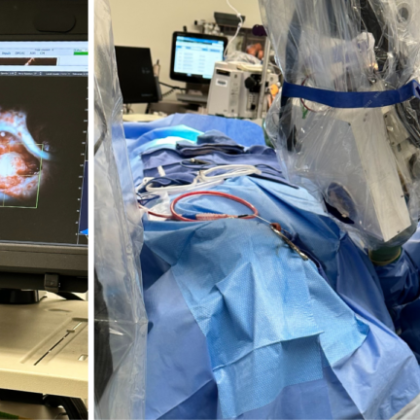
On the left, the computer screen displays the video image and two OCT images taken during the surgery. On the right, Oghalai is collecting data while performing the surgery. (Photo by John Oghalai); featured image for An innovative approach to hearing loss: John Oghalai receives R01 grant for OCT imaging of the human inner ear

An innovative approach to hearing loss: John Oghalai receives R01 grant for OCT imaging of the human inner ear

Over 615,000 people in the United States alone are affected by Meniere’s disease, a problem of the inner ear that can lead to vertigo (dizziness) and hearing loss, and many more experience …

Illustration of sound waves entering the ear (Image courtesy of iStock); featured image for Nerve fibers in the inner ear adjust sound levels and help compensate for hearing loss in mice, study finds

Nerve fibers in the inner ear adjust sound levels and help compensate for hearing loss in mice, study finds

Researchers from the Keck School of Medicine of USC, in collaboration with Baylor College of Medicine in Houston, Texas, used an innovative imaging tool to examine the mouse inner ear and made …

Ear exam; featured image for Study reveals common loud noises cause fluid buildup in the inner ear and suggests simple possible cure for noise-induced hearing loss

Study reveals common loud noises cause fluid buildup in the inner ear and suggests simple possible cure for noise-induced hearing loss

Exposure to loud noise, such as a firecracker or an ear-splitting concert, is the most common preventable cause of hearing loss. Research suggests that 12% or more of the world population is …
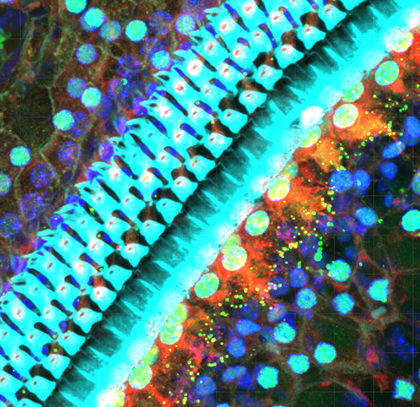
Synapses in the mammalian cochlea (Image courtesy of Juemei Wang); featured image for Simple treatment may minimize hearing loss triggered by loud noises

Simple treatment may minimize hearing loss triggered by loud noises

It’s well known that exposure to extremely loud noises — whether it’s an explosion, a firecracker or even a concert — can lead to permanent hearing loss. But knowing how to treat …